|
|
|
|
Mediterranean Destinations
|

 Find
Rome Find
Rome |

 More Photos
|

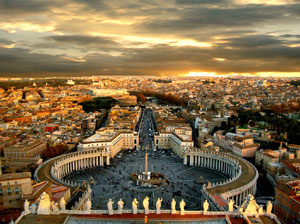
Rome, is the capital city of Italy as well as the country's largest and most populous city, with more than 2.7 million residents. It is located in the central-western portion of the Italian peninsula, on the Tiber river.
Ancient Rome was a major center of Western civilization, and Rome is seat of the Roman Catholic Church which controls the Vatican City as its sovereign territory, an enclave of Rome.
Today, Rome is modern and cosmopolitan. It is the third most-visited tourist destination in the European Union and a city of cultural and political importance.
As one of the few major European cities that escaped World War II relatively unscathed, central Rome remains essentially Renaissance and Baroque in character, with many ancient monuments from the Roman Empire, including the Palentine Hills, Roman Forum, Colosseum, and Pantheon.
History
According to a legend, Rome was founded by the twins Romulus and Remus on April 21, 753 BC. Archaeological evidence supports the view that Rome grew from pastoral settlements on the Palatine Hill built in the area of the future Roman Forum. The original settlement developed into the capital of the Roman Kingdom (ruled by a succession of seven kings, according to tradition), and then the Roman Republic (from 510 BC, governed by the Senate), and finally the Roman Empire (from 27 BC, ruled by an Emperor). This success depended on military conquest, commercial predominance, as well as selective assimilation of neighbouring civilizations, most notably the Etruscans and Greeks. From the its foundation, Rome was undefeated in war, although losing occasional battles, until 386 BC when Rome was occupied by the Celts (one of the three main Gallic tribes), and then recovered by Romans in the same year. According to the history, the Gauls offered to deliver Rome back to its people for a thousand pounds of gold, but the Romans refused, preferring to take back their city by force of arms rather than ever admitting defeat.
Roman dominance expanded over most of Europe and the shores of the Mediterranean Sea, while its population surpassed one million inhabitants. For almost a thousand years, Rome was the most politically important, richest and largest city in the Western world, until the fall of the Western Roman Empire.
Rise of the Catholic Church
With the reign of Constantine I, the Bishop of Rome gained political as well as religious importance, eventually becoming known as the Pope and establishing Rome as the centre of the Catholic Church. After the Sack of Rome in AD 410 by Alaric I and the fall of the Western Roman Empire in AD 476, Rome alternated between Byzantine and plundering by Germanic barbarians. Its population declined to a mere 20,000 during the Early Middle Ages, reducing the sprawling city to groups of inhabited buildings interspersed among large areas of ruins and vegetation. Rome remained nominally part of the Byzantine Empire rule until AD 751 when the Lombards finally abolished the Exarchate of Ravenna. In 756, Pepin the Short gave the pope temporal jurisdiction over Rome and surrounding areas, thus creating the Papal States.
Rome remained the capital of the Papal States until its annexation into the Kingdom of Italy in 1870; the city became a major pilgrimage site during the Middle Ages and the focus of struggles between the Papacy and the Holy Roman Empire starting with Charlemagne, who was crowned its first emperor in Rome on Christmas 800 AD by Pope Leo III. Apart from brief periods as an independent city during the Middle Ages, Rome kept its status of Papal capital and "holy city" for centuries, even when the Pope briefly relocated to Avignon (1309–1337).
The latter half of the 15th century saw the seat of the Italian Renaissance move to Rome from Florence. The popes wanted to equal and surpass the grandeur of other Italian cities and to this end created ever more extravagant churches, bridges and public spaces, including a new Saint Peter's Basilica, the Sistine Chapel, Ponte Sisto (the first bridge to be built across the Tiber since antiquity), and Piazza Navona. The Popes were also patrians of the arts engaging such artists as Michelangelo, Perugino, Raphael, Ghirlandaio, Luca Signorelli, Botticelli and Cosimo Rosselli.
The period was also infamous for papal corruption with many popes fathering children, and engaging in nepotism and simony. The corruption of the Popes and the extravagance of their building projects led, in part, to the Reformation and, in turn, the Counter-reformation.
|
Important Sites: |
Related Websites of Interest: |
| 2008 World-Cruises.org - All text available under GNU Free Documentation License. Attribution of Photos Required. |
 |