Mediterranean Destinations
|
 Find
Tangier Find
Tangier |

More Photos
|
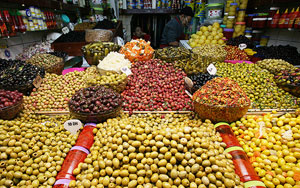
Tangier is a city of northern Morocco with a population of 669,680. It lies on the North African coast at the western entrance to the Strait of Gibraltar where the Mediterranean meets the Atlantic Ocean off Cape Spartel.
History
The modern Tangier is an ancient Phoenician town, founded by Carthaginian colonists in the early 5th century BC. The Berber's ascribe the founding of the city to Sufax, the son of the Berber goddess Tinjis, while the Greeks suggested the founder was really the son of Hercules The cave of Hercules, a few miles from the city, is a major tourist attraction. It is believed that Hercules slept there before attempting one of his twelve labours.
Tangier came under Roman rule in the 1st century BC. 1st century BC, under Augustus, It was the scene of the martyrdoms of Saint Marcellus of Tangier. In the 5th century AD, Vandals conquered the city, Morocco and much of North Africa. Following the Vandals in 534 A.D. were the Byzantine Empire, the Arabs in 702, and ultimately fell under both Spanish and French rule, before gaining independence in 1956.
Around Tangiers
For most visitors, the interesting parts of Morocco, lie outside Tangiers in Morocco's interior. These attractions include;
 More Photos
|
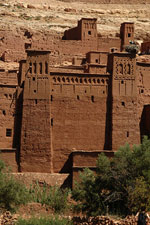
Aït Benhaddou is a 'fortified city', or ksar, along the former caravan route between the Sahara and Marrakech in present-day Morocco. It is situated in Souss-Massa-Draâ on a hill along the Ouarzazate River and has some beautiful examples of kasbahs (high walled, windowless fortresses). Due to its unique beauty, Aït Benhaddou has featured prominently in a number of Hollywood movies, including Lawrence of Arabia and Gladiator.
Marrakech 
Marrakech or Marrakesh, known as the "Red City" or "Al Hamra," is a city with a population of 1,036,500 (as of 2006) in southwestern Morocco, near the foothills of the Atlas Mountains. Marrakech has the largest traditional market (souk) in Morocco and also has one of the busiest squares in Africa, Djemaa el Fna. The square bustles with acrobats, story-tellers, water sellers, dancers, and musicians
For centuries Marrakesh has been known for its 'seven saints.' When sufism was at the height of its popularity, during the reign of Moulay Ismail, the festival of the 'seven saints' was founded by Abu Ali al-Hassan al-Yusi at the request of the sultan. The tombs of several renowned figures were moved to Marrakesh to attract pilgrims in the same way Essaouira did at that time with its Regrega festivals. The 'seven saints' (sebaatou rizjel) is now a firmly established institution, attracting visitors from everywhere. The seven saints include Sidi Bel Abbas (the patron saint of the city), Sidi Muhammad al-Jazuli, Sidi Abu al-Qasim Al-Suhayli, Cadi Ayyad ben Moussa, and Abdallah al-Ghazwani.
More Photos
|
Chefchaouen
Chefchaouen is a city in northwest Morocco, located in the Rif Mountains, just south of Tangiers and Tetouan. The city was founded in 1471, as a small fortress which still exists to this day, by Moorish exiles from Spain led by Moulay Ali Ben Moussa Ben Rached El Alami to fight the Portuguese invasions of northern Morocco. It was known as one of the main concentrations of Moriscos and Jews who sought refuge in this mountainous city after the Spanish Reconquista in medieval times. In 1920, the Spanish seized Chefchaouen to form part of Spanish Morocco. Spanish troops imprisoned Abd el-Krim in the kasbah in 1926 after defeating him with the help of the French force. Spain returned the city after the independence of Morocco in 1956.
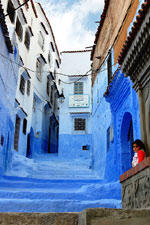
Chefchaouen or Chaouen, as it is often called by Moroccans, is a popular tourist destination given its proximity to Tangier and the Spanish border. The name simply refers to the shapes of the mountain tops that tower over the town, that look like the two horns (chaoua) of a goat. "Chef Chaouen" literally means "look at the horns". There are approximately two hundred hotels in this tiny mountain village in order to host the summer influx of European tourists. One distinction possessed by Chefchaouen is its blue-rinsed houses and buildings, a tradition that comes from the town's former Jewish population.
Chefchaouen is a popular shopping destination as well, as it offers many native handicrafts that are not available elsewhere in Morocco, such as wool garments and woven blankets. The goat cheese native to the area is also popular with tourists.
|
Related Websites of Interest: |